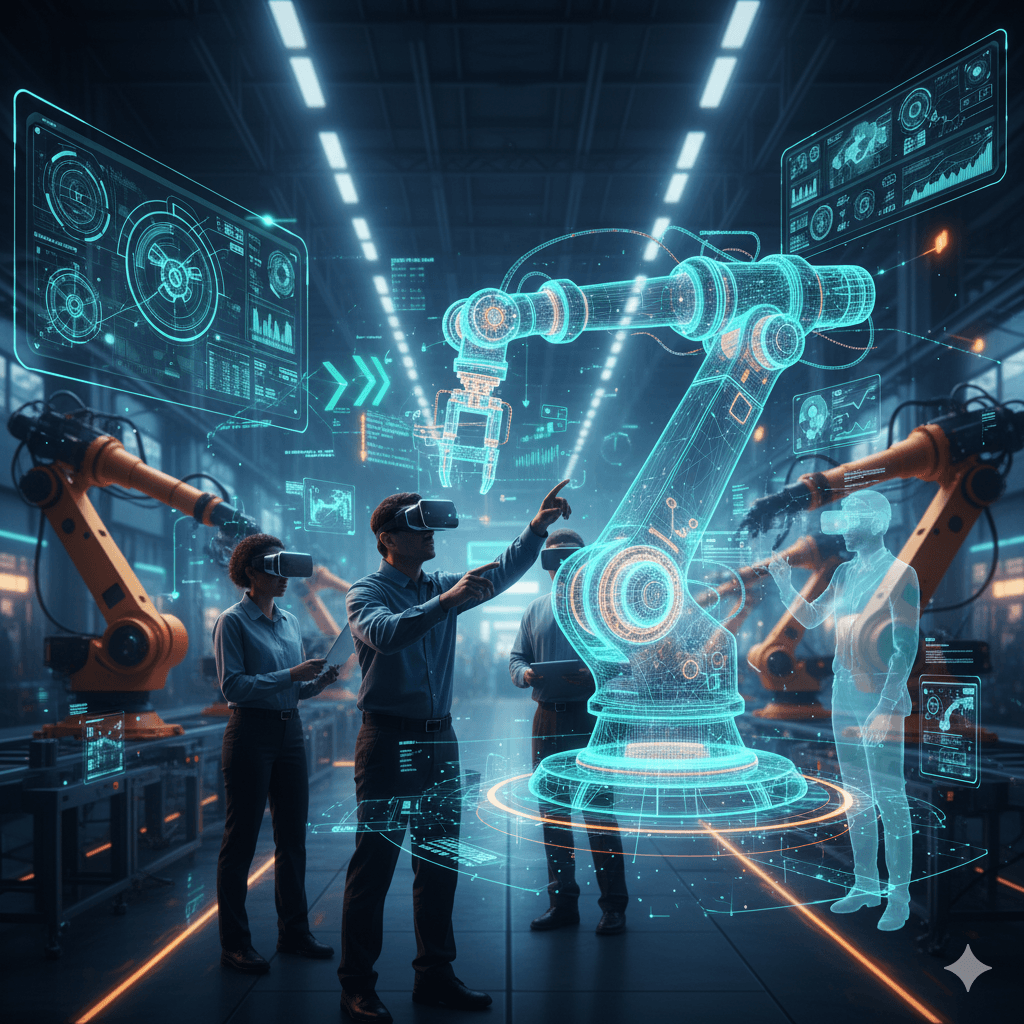
The Industrial Metaverse: Blending Real and Virtual for Next-Gen Manufacturing
The Industrial Metaverse is the next evolution of Industry 4.0, moving beyond simple automation to create a dynamic, interconnected digital universe. It represents the seamless blending of the physical world with its digital twin counterpart, enabling real-time interaction, analysis, and optimization across the entire product lifecycle.
Core Pillars of the Industrial Metaverse
This industrial transformation is powered by the convergence of three foundational technologies:
*
Key Enterprise Use Cases
### 1. Virtual Prototyping and Collaborative Design
Companies like BMW and Honda are leveraging VR to visualize and interact with 3D CAD models. Engineers from global locations can collaboratively review designs in a shared virtual space, effectively eliminating the need to build and ship costly physical prototypes. This dramatically cuts development time and costs.
### 2. Hands-on Training and Workforce Support
VR and AR simulations offer risk-free training environments. Instead of traveling to a physical site, new hires can practice complex, high-risk procedures—such as equipment maintenance or assembly—in a virtual factory. This results in much higher information retention and skill acquisition compared to traditional methods. For example, Boeing and Ford use AR overlays to provide step-by-step instructions directly onto the physical equipment, minimizing human error and downtime.
### 3. Remote Operations and Maintenance
MR headsets enable powerful 'see-what-I-see' remote assistance. A field technician can connect with a subject matter expert miles away. The expert can draw annotations, place 3D arrows, or share documentation directly into the technician's field of view (via AR), guiding them through complex repairs or inspections in real-time without physically traveling.
*
The Financial Impact
The market is rapidly embracing this shift. The manufacturing and resources sector alone allocates billions to AR/VR technology. Organizations that successfully blend virtual and physical experiences often see significant ROI, with some reports indicating 30% or more return on investment in MR, driven primarily by improved workforce productivity and reduced operational expenses.
In essence, the Industrial Metaverse is poised to be the central command center where digital and real worlds unite, accelerating product development and delivering unprecedented operational efficiency.
Enjoyed reading this?
I love discussing WordPress, AI automation, and web development. If you have a project in mind or just want to chat, let's connect!
Want to dive deeper?
Book a Strategy Call